Cavalier King Charles spaniel portraits in The Stencil
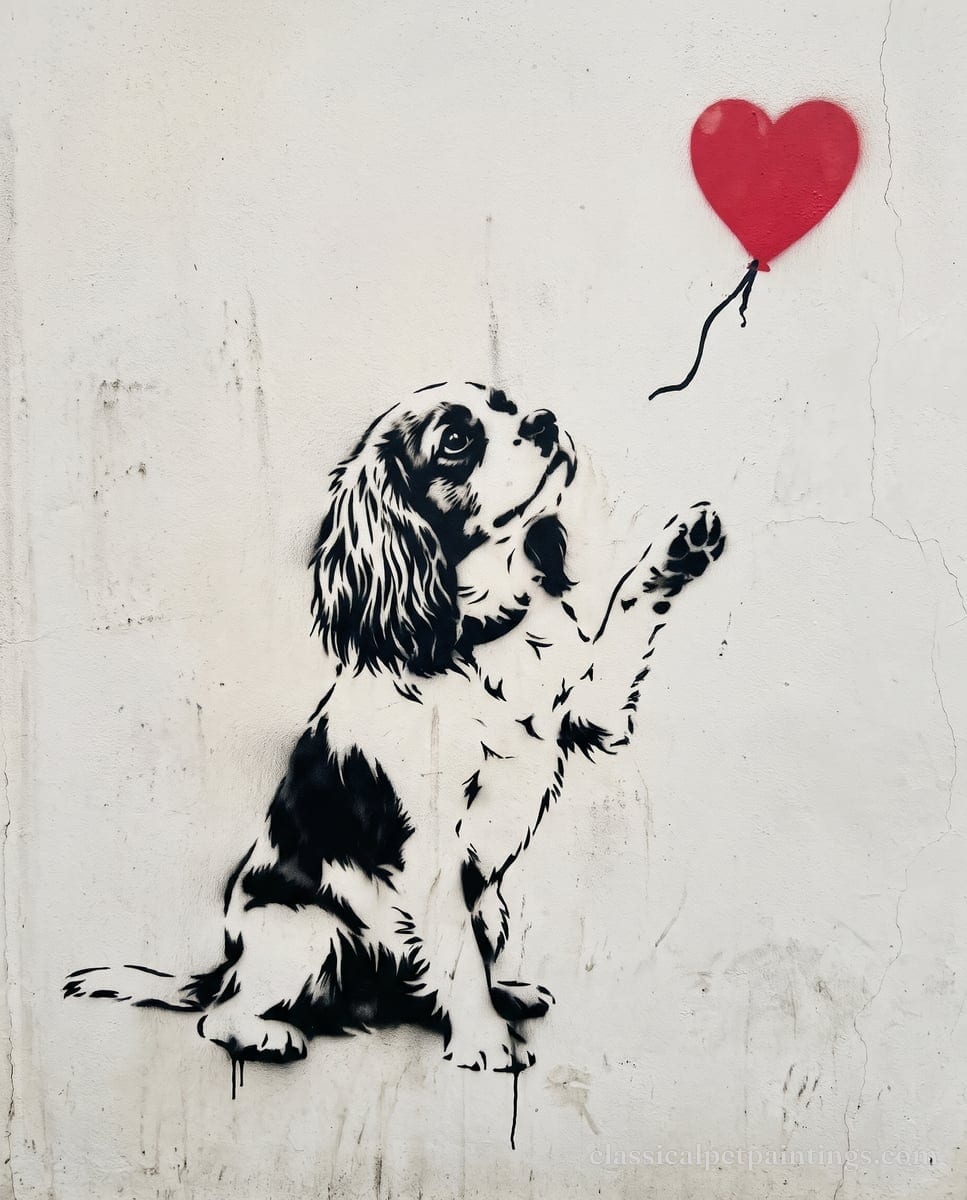
Your Cavalier in black spray paint on a bare wall, long ears and all, with one red heart balloon, painted from one photo of your own dog.
Examples
A royal lap dog brought back from old portraits
Toy spaniels were the dogs of European nobility from at least Renaissance times. Two 17th-century British kings, Charles I and his son Charles II, were especially devoted to a black and tan variety of toy spaniel, later named in Charles II's honor. The diarist Samuel Pepys wrote that Charles II seemed more concerned with breeding spaniels than with ruling Britain. Later the Marlborough family bred a red-and-white line at Blenheim Palace, and the color is still called Blenheim.
In Victorian times the toy spaniel was crossed with Asian toy breeds and came out with a domed skull and a flat face, the dog known in America as the English Toy Spaniel. The older type, the one in the ancestor portraits in English country houses, nearly vanished. In the 1920s an American, Roswell Eldridge, offered prize money to British breeders who could produce Blenheim spaniels of the old world type. The dogs they bred back were named Cavalier King Charles Spaniels, after the party that stood by the Stuart kings. The AKC fully recognized the breed in 1995.
The standard describes an active, graceful toy spaniel of 12 to 13 inches at the shoulder and 13 to 18 pounds. It names the sweet, gentle, melting expression of the large, round, very dark eyes as a breed characteristic. The ears are set high and long, with plenty of feathering, and fan forward to frame the face when the dog is alert. The silky coat is never trimmed: the standard calls a natural look essential to the breed.
Four colors are allowed. Blenheim is rich chestnut on pearly white, with a white blaze between the eyes and ears that may hold a chestnut spot, the lozenge. Tricolor is jet black on white, with tan over the eyes, on the cheeks and inside the ears. Black and tan is jet black with bright tan points, and ruby is a whole rich red. The AKC calls the Cavalier affectionate, gentle and graceful, an eager-to-please dog that is as happy on a long walk as on the sofa.
The Stencil on a Cavalier
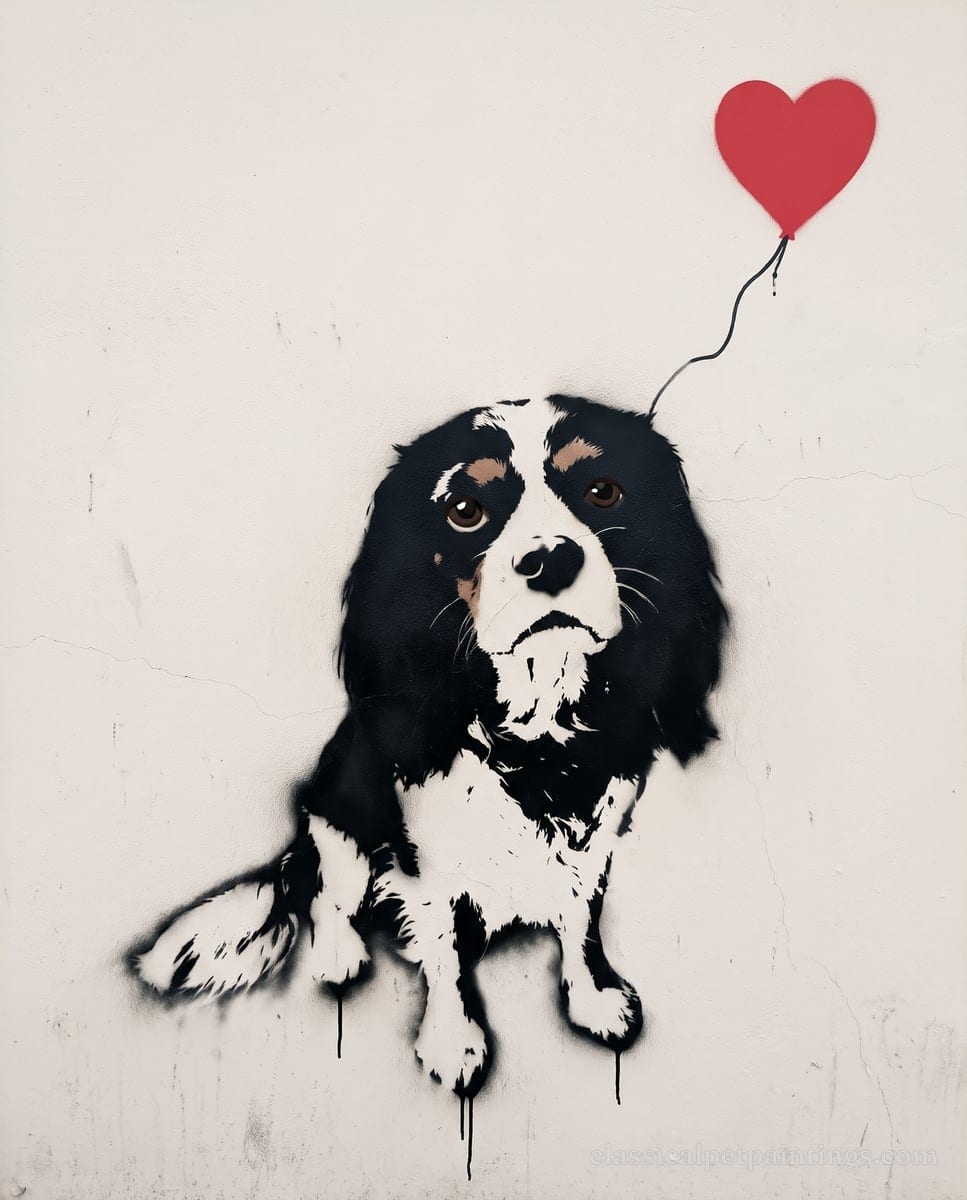
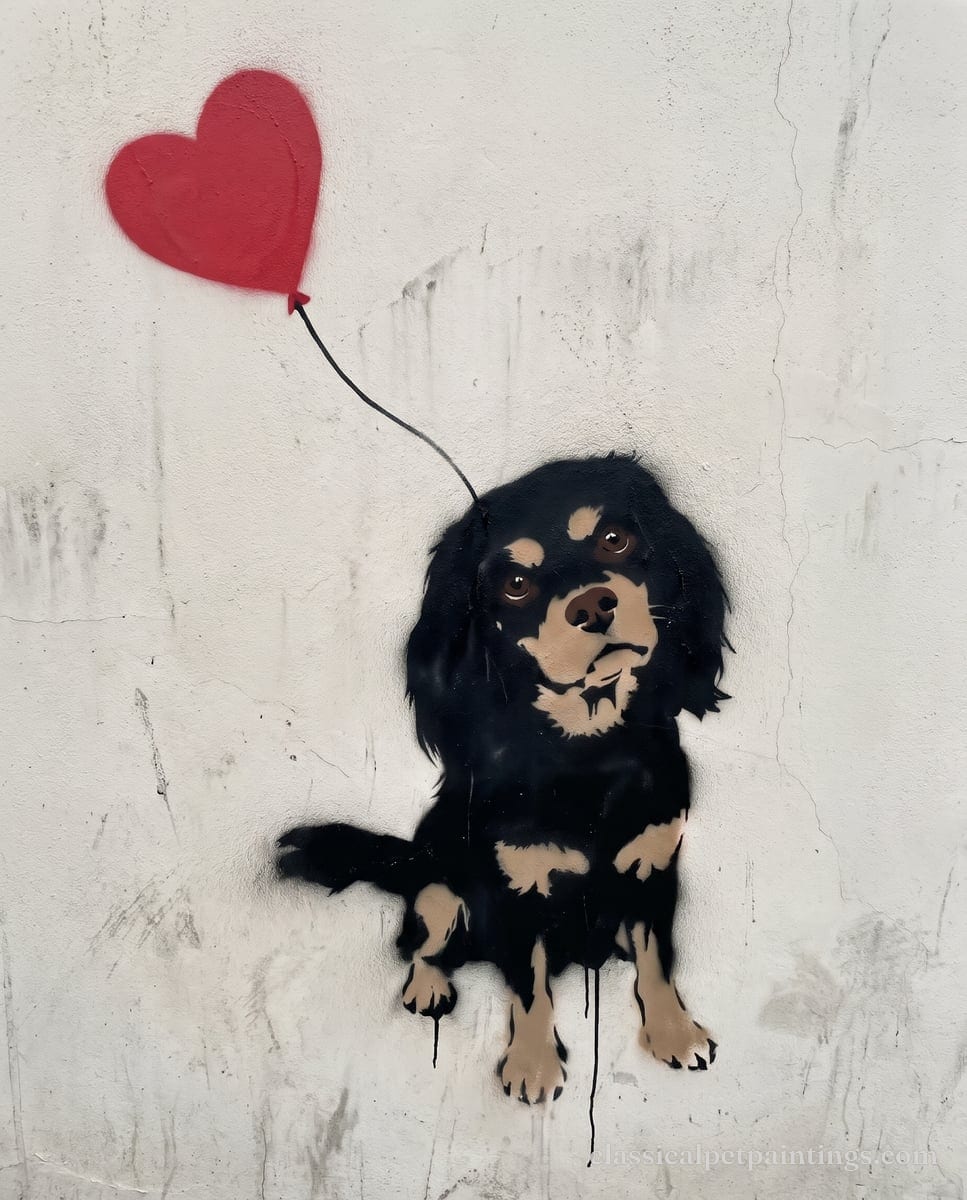
The Stencil is one of the shop's own house styles. It paints the pet in black spray paint on a bare, cracked, off-white wall, with one red heart-shaped balloon on a thin black string floating beside it. Black paint, the wall and the red balloon carry the picture, with no other background. Thin drips of paint run down from the paws.
A stencil has only two tones, so the fur is cut into sharp shapes of paint and bare wall. That suits a Cavalier well. The breed is defined by its markings: the dark ears and eye patches of a Blenheim or a tricolor against the white blaze, and the long feathered ears. In stencil those become the whole picture, and the soft, round-eyed Cavalier face still reads at a glance.
The black parts of a coat go down as black paint, and so does the chestnut of a Blenheim, with every patch kept in its place. The tan points of a tricolor and of a black and tan stay a warm tan. The feathered tail and the long ears come through on every dog.
The scene is the style's own. Whatever your Cavalier is doing in the photo, The Stencil sets it sitting up against the wall under its balloon, sometimes looking up at it and sometimes reaching a paw up toward it. The ears, the markings and the expression come from your photo.
A gift for a Cavalier's people
The Cavalier is a breed that was brought back because people went looking for the dogs in old portraits. A portrait suits it. The Stencil turns that idea around: instead of an oil painting in a gilt frame, a Cavalier on a bare wall, holding on to one red heart.
It suits a new puppy, a birthday, or a Cavalier that has spent years on someone's lap. For a Cavalier that has died, an older photo works too. Choose one where both ears and the markings around the eyes can be seen, because the stencil is built from them.
Questions
Will the chestnut of my Blenheim Cavalier show in the painting?
In the Blenheim example the chestnut went down as black paint, with the markings kept in their places, while the tan points of a tricolor and a black and tan stayed tan. You see the painting before you pay, and another photo or another style is free.
My Cavalier is lying on the sofa in every photo. Will that work?
Yes. The Stencil sets every pet sitting up against a bare wall under a red balloon, whatever it is doing in the photo. A photo of your Cavalier lying down works, as long as the face, the ears and the markings are clear.
Does the painting keep a Cavalier's long feathered ears?
Yes. The ears come from your photo, and in a two-tone stencil their long feathering is one of the strongest shapes in the picture. Choose a photo where both ears hang free and are not hidden by a collar, a harness or a hand.
What photo of a Cavalier works best?
Daylight, the face in focus, and the whole head in the frame. The dark eyes of a tricolor or a black and tan Cavalier sit inside dark patches, so they need good light to stand out. Phone photos are fine. Avoid filters, costumes and heavy shadows.
Your pet, in The Stencil
Fine-art print
- 8×10"
- $89
- 12×16"
- $92
- 12×18"
- $95
- 18×24"
- $115
- 24×36"
- $127
Luxury canvas
- 12×16"
- $149
- 12×18"
- $157
- 18×24"
- $199
- 24×36"
- $254
- 28×40"
- $399
- 40×60"
- $849
Digital file
- Download
- $39