German shepherd portraits in three close-up studies
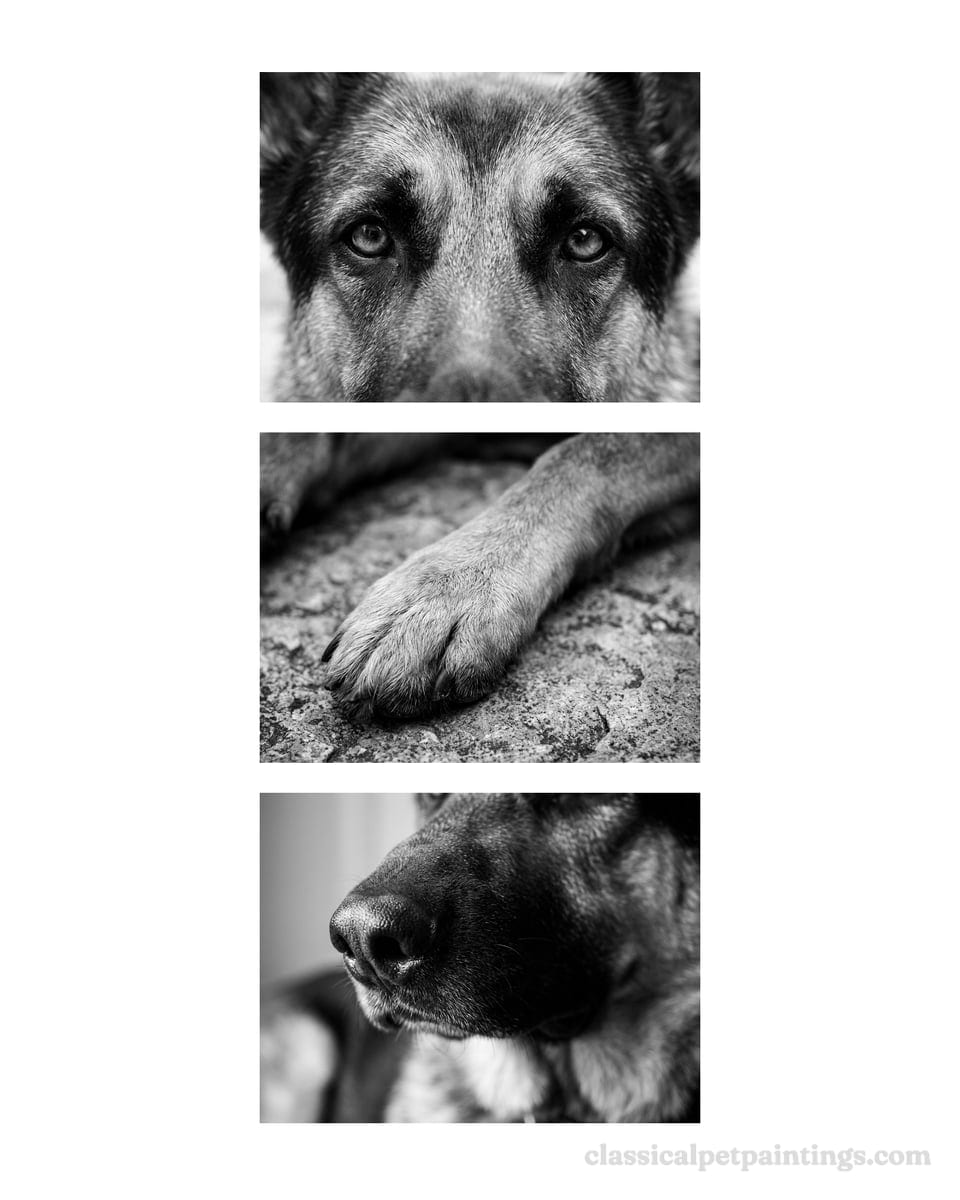
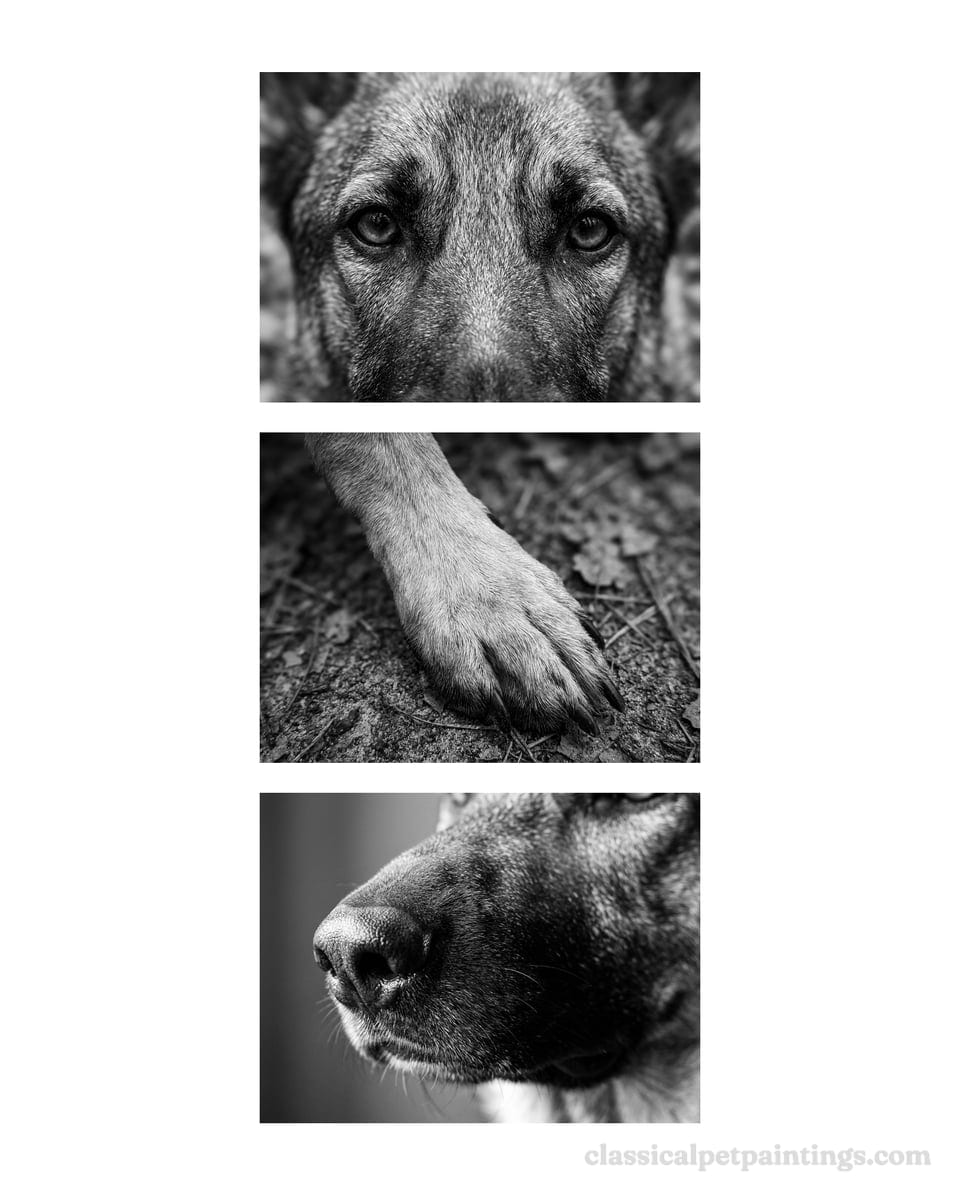
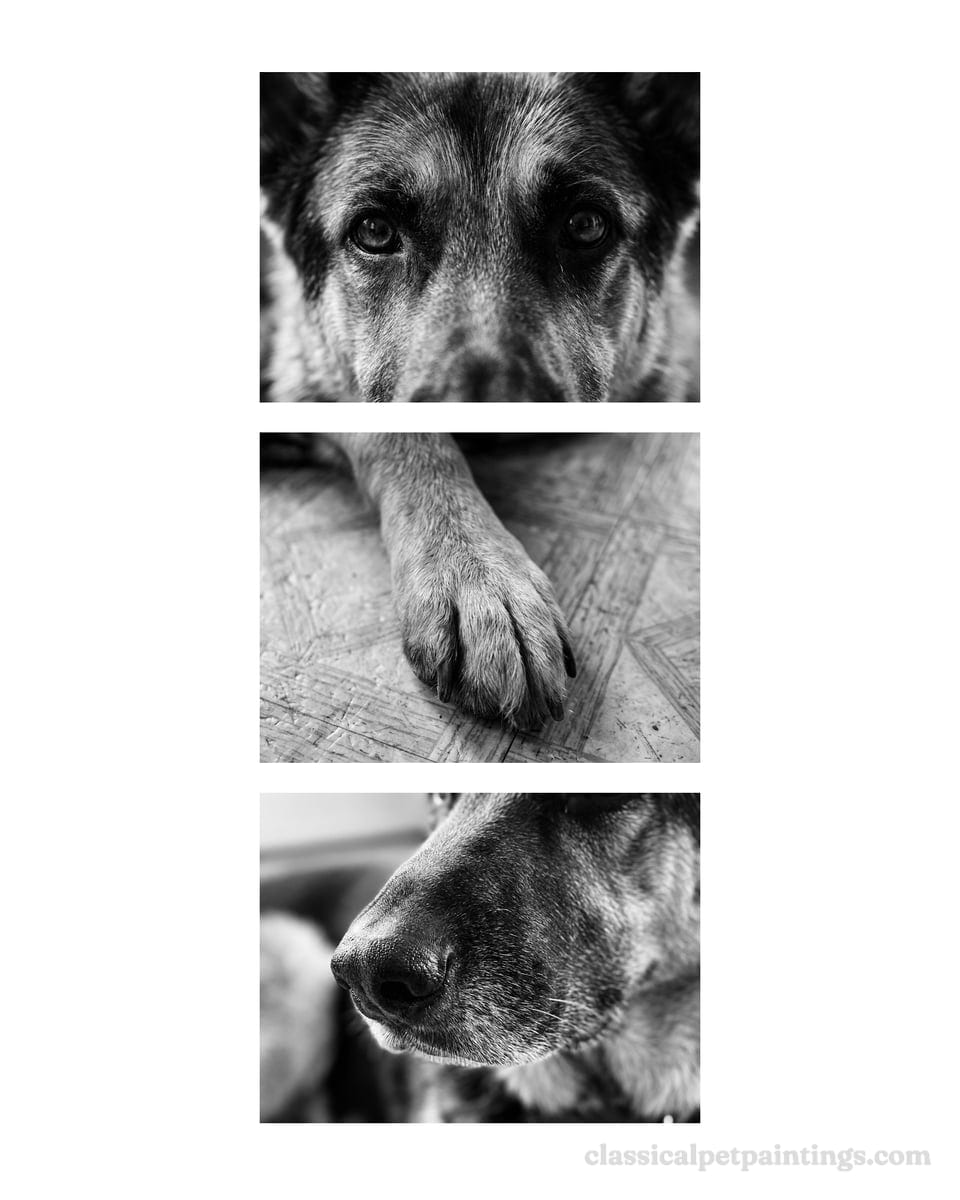
Your German shepherd's eyes, nose and paw in three black-and-white close-up studies, made from one photo of your own dog.
Examples
A herding dog shaped by one cavalry officer
The German shepherd comes from the herding dogs of Germany, which until the late 19th century varied in type from district to district. In the last years of the 1800s, Captain Max von Stephanitz, a German cavalry officer, set out to make the ideal German herder, crossing strains from the north and the center of the country. He co-founded the first club for the breed and spent 35 years promoting and refining it.
The AKC puts it plainly: the breed's intelligence, agility and air of firm authority were formed in the sheep pasture, not the police academy. As herding declined, von Stephanitz promoted the shepherd as a working dog, and it is now a preferred dog of police and military units around the world. In America it grew popular in the early 1900s, helped by the film dogs Rin-Tin-Tin and Strongheart; in Britain it was called the Alsatian from the First World War on.
The standard describes a direct and fearless, but not hostile, expression, self-confidence, and a certain aloofness that does not lend itself to immediate and indiscriminate friendships. It permits most colors and prefers strong, rich ones. The AKC recognized the breed in 1908, and it has been fourth in AKC registrations every year since 2021.
Three Things on a German shepherd
Three Things is one of the shop's own house styles: three close-up studies of one pet, stacked one over the other, in fine-grained black and white with soft light from one side and the focus falling away behind. When the photo shows the face, the three are the eyes, the nose and a front paw.
Those are the parts the German shepherd's standard dwells on. It asks for almond-shaped eyes, set a little obliquely and as dark as possible, with a keen, intelligent and composed expression; a long, wedge-shaped muzzle and a black nose; and short, compact feet with well-arched toes, thick pads and short, dark nails.
Black and white suits the breed's markings. The dark mask, the tan brows over the eyes and the black saddle become deep blacks and silver grays, and a sable's dark-tipped coat shows hair by hair. The pattern is your dog's own, from your photo.
A gift for a shepherd's person
The AKC notes that the German shepherd is known as a one-man breed for its loyalty to its owner. Three Things is a portrait of the details that one person knows best: the look across the room, the nose at the elbow, the paw on the floor beside the bed.
It suits a birthday, a working dog's retirement, or a shepherd that has died: three small studies keep the parts of a dog people miss most. An old photo works too.
Questions
Which three details does the portrait show?
When your photo shows the face, the three studies are the eyes, the nose and a front paw. When the face is hidden, features the photo does show, such as the ears, the chest or the tail, take the place of the eyes and the nose.
Will it look like my German shepherd?
Yes. The studies are made from your photo, so the eyes, the markings and any gray on the muzzle are your dog's. You see the portrait before you pay, and you can try another photo or style first.
Is the portrait in color?
No. All three studies are in black and white with the coat's own light and dark pattern kept, so the mask, the saddle and the tan points show as tones of gray.
What photo of a shepherd works best?
Daylight, the face in focus, both eyes and both ears in the frame. The paw is painted in your dog's own coat even when the photo shows none. Phone photos are fine. Avoid filters, costumes and heavy shadows.
Your pet, in Three Things
Fine-art print
- 8×10"
- $89
- 12×16"
- $92
- 12×18"
- $95
- 18×24"
- $115
- 24×36"
- $127
Luxury canvas
- 12×16"
- $149
- 12×18"
- $157
- 18×24"
- $199
- 24×36"
- $254
- 28×40"
- $399
- 40×60"
- $849
Digital file
- Download
- $39