Rottweiler portraits in the Play style
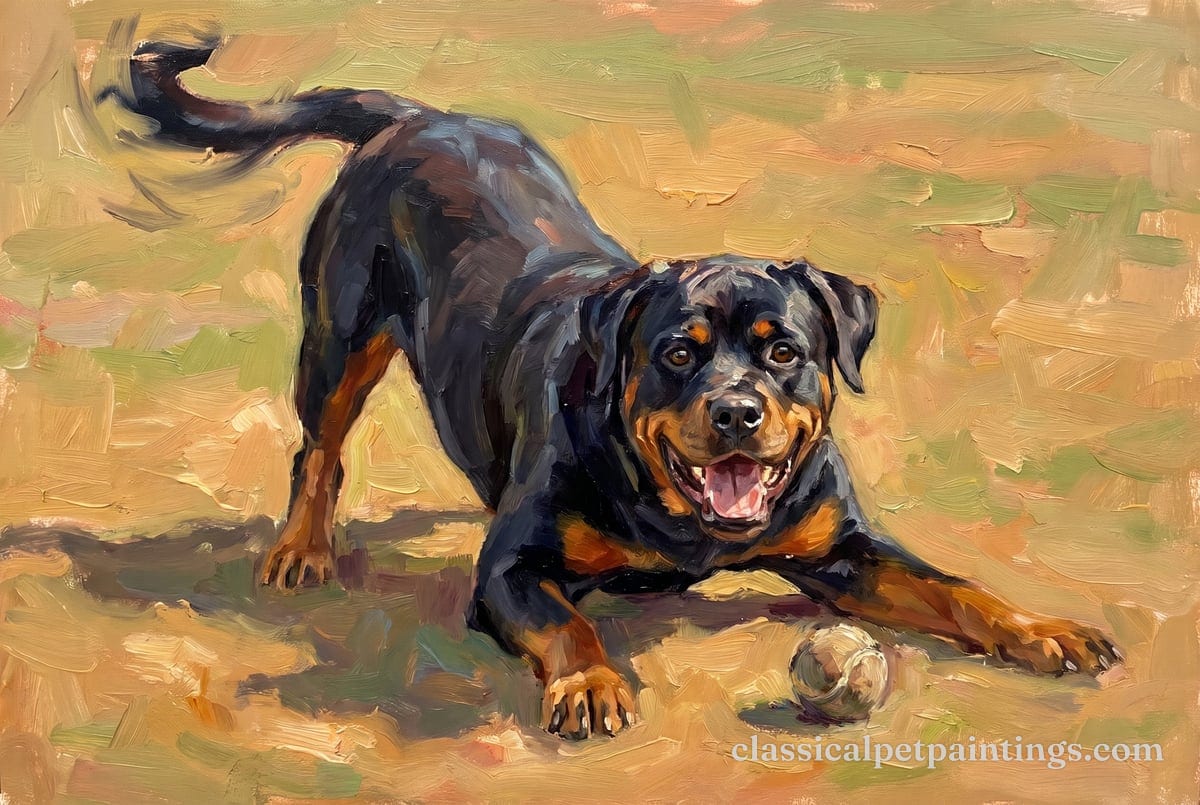
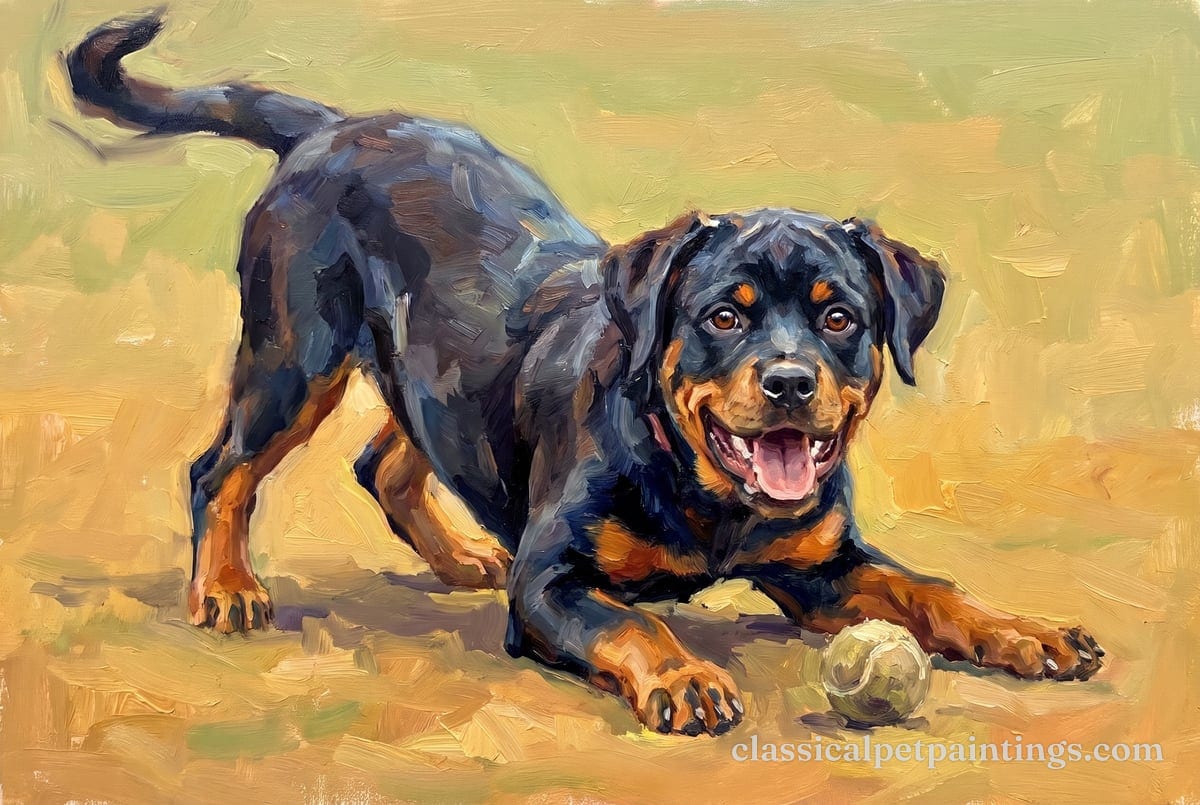
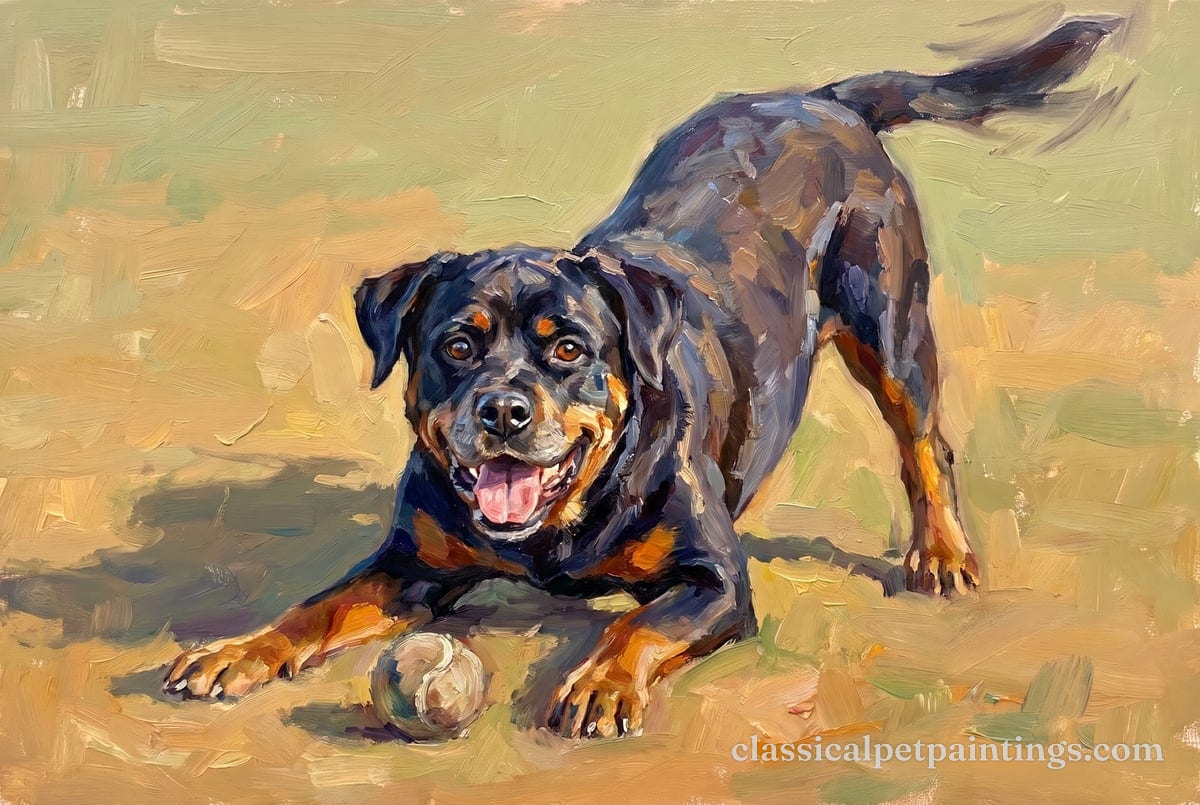
Your Rottweiler down in a play bow, a ball at its paws, in thick sunlit oil paint, painted from one photo of your own dog.
Examples
The butcher's dog of Rottweil
The Rottweiler's story starts with the Roman legions. The AKC traces the breed to the mastiff-type drover dogs the Romans took north to move and guard the herds that fed the army. After the empire fell, those dogs found work in the German cattle town of Rottweil, driving herds from pasture to market and guarding them from bandits and rustlers on the road. The town gave them their name: Rottweiler Metzgerhund, the butcher's dog of Rottweil.
When railway cattle cars took over the trade in the 1800s, the breed found new work as a police dog, a guardian and an all-round working dog. Rottweilers were among the first guide dogs for the blind, and in recent times they searched the disaster sites of Oklahoma City and the World Trade Center. The AKC notes that the breed has changed little in form and temper since its first German standard of 1901.
The look is fixed by the standard: always black with rust to mahogany markings, sharply edged, in set places. A spot over each eye, the cheeks, a strip down each side of the muzzle, the throat, a triangle on each side of the chest, and the forelegs from the wrist down to the toes. The coat is straight, coarse and lies flat, shortest on the head and legs.
To strangers the Rottweiler is calm and aloof, with what the standard calls a wait-and-see attitude. At home it is another dog. The AKC writes that this aloof front belies the playfulness, and downright silliness, that endear Rotties to their people, and that nobody told the Rottie he is not a toy breed, so he may climb onto a lap for a cuddle.
The Play style on a Rottweiler
Play is one of the shop's own house styles, not a copy of an old master. It paints the moment a game starts: front legs flat on the ground, chest low, hindquarters up, eyes on you and a ball at the paws. The view is low and wide, as if from the grass, on a warm field of ocher and soft green under full sun.
The paint is thick oil laid on in quick, broad strokes, loose in the ground and tighter in the face. On a Rottweiler the black coat is never one flat black: the sun turns the back and shoulders blue and violet, and the shadow under the dog falls cool on the warm ground.
The rust markings are what make a Rottweiler read at a glance, and the style keeps them bright against the black, from the spots over the eyes to the chest and the legs. The face, the markings and the build come from your photo; the pose, the ball and the field come from Play.
Play suits the side of the breed that strangers seldom see. A dog known for guarding, painted mid-game with its mouth open, is the Rottweiler its own family knows.
A gift for a Rottweiler's family
Most Rottweiler owners know what strangers think of their dog. This painting shows what the family sees: the grin, the low bow and the eyes asking for one more throw.
It suits a big dog's birthday, a young dog that has just grown into its paws, or an old Rottie with gray in the muzzle. For a Rottweiler that has died, an old photo works too. Choose one where the face and the rust markings are clear, because the painting is built around them.
Questions
Will the painting look like my Rottweiler?
Yes. The painting is made from your photo, so the face, the markings and the build are your dog's. The pose and the ball are the style's. You see the painting before you pay, and you can try another photo or style first.
Does my Rottweiler need to be playing in the photo?
No. Play paints every dog in the same play bow with a ball, whatever the pose in the photo. A photo of your dog sitting, standing or lying down works, as long as the face and the markings are clear.
Will a black coat look flat in the painting?
No. The style paints the black in blues, violets and warm browns where the sun catches it, and keeps the deepest black for the shadows, so the shape of the head and the muscle of the shoulders still show.
What photo of a Rottweiler works best?
Daylight, both eyes in focus, and the whole dog in the frame. A black coat loses its detail in deep shade or under a flash, so soft outdoor light shows the markings best. Phone photos are fine. Avoid filters and heavy shadows.
Your pet, in Play
Fine-art print
- 8×10"
- $89
- 12×16"
- $92
- 12×18"
- $95
- 18×24"
- $115
- 24×36"
- $127
Luxury canvas
- 12×16"
- $149
- 12×18"
- $157
- 18×24"
- $199
- 24×36"
- $254
- 28×40"
- $399
- 40×60"
- $849
Digital file
- Download
- $39